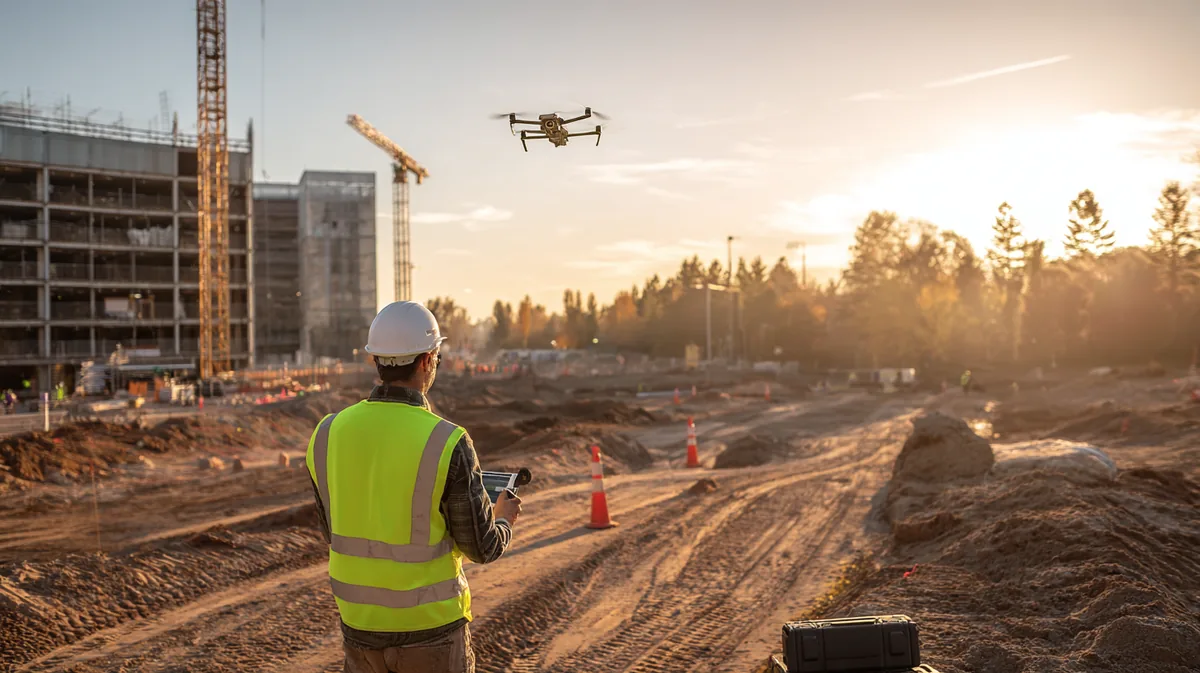
There is no single official drone pilot salary. The U.S. Bureau of Labor Statistics (BLS) does not publish a separate Occupational Outlook Handbook profile for drone pilots; its index sends “Unmanned Aerial Vehicle Operator” to a broader technician occupation, and drone work also shows up inside occupations such as photographers and surveying and mapping technicians. For those related occupations, the BLS reports May 2025 median pay of $44,660 a year for photographers, $54,240 for surveying and mapping technicians and $73,900 for electro-mechanical and mechatronics technologists and technicians. So how much do drone pilots make? It depends on the industry you fly in, what you deliver after you land, whether you are an employee or self-employed, and which FAA rules and authorizations you can work under.
This guide explains what the official figures do and do not tell you, the factors that move drone pilot pay up or down, and the legal baseline every paid pilot needs first. It is general information, not financial advice, and it is not a promise of any income or job.
Why There Is No Single Drone Pilot Salary Figure
Salary websites publish drone pilot numbers, but they rarely agree, because they rely on job ads and self-reported salaries with different samples and methods. Job titles vary too: the same work may be advertised as remote pilot, UAS operator, aerial photographer, survey technician or inspection technician.
Many people who fly for pay are not full-time “drone pilots” at all. A real estate photographer, a roofer, a surveyor or a farmer may use a drone as one tool in a larger job. Others are self-employed and set their own rates. That matters for official data: the BLS notes that its wage figures come from the Occupational Employment and Wage Statistics survey, which does not include self-employed workers.
What Official BLS Data Shows for Related Occupations
The most reliable public numbers come from the BLS Occupational Outlook Handbook. None of these occupations is “drone pilot”, but each one either mentions drones in its description or is where the BLS index points drone operator titles.
| Occupation (BLS) | How drones appear | Median pay, May 2025 | Lowest 10 / highest 10 percent |
|---|---|---|---|
| Photographers | Aerial photographers may use drones to photograph buildings, landscapes, scenery or events | $44,660 a year ($21.47 an hour) | Under $14.82 / over $44.14 an hour |
| Surveying and mapping technicians | May use drones to take photos for survey work | $54,240 a year ($26.08 an hour) | Under $37,520 / over $81,630 a year |
| Electro-mechanical and mechatronics technologists and technicians | Index entry for “Unmanned Aerial Vehicle Operator”; work with unmanned and robotic equipment | $73,900 a year ($35.53 an hour) | Under $47,840 / over $109,890 a year |
For comparison, the BLS reports a May 2025 median of $50,980 for all workers. Read these figures carefully. They describe everyone in the occupation, not just the time spent flying, and the electro-mechanical group covers a much wider range of industrial work than drones. The BLS photographers profile also reports that 67 percent of photographers were self-employed in 2025, and their earnings are not in the wage figures.
Industry alone makes a large difference. For surveying and mapping technicians, the BLS lists May 2025 median wages of $77,310 in utilities, $61,650 in local government, $56,880 in construction and $50,340 in architectural, engineering and related services.
The Factors That Drive Drone Pilot Pay
Two pilots with the same certificate and the same aircraft can earn very different amounts. These are the factors that usually matter most.
Industry and client
Utilities, infrastructure, construction and government clients often need repeatable, documented data and strict safety procedures. Consumer and small-business work, such as real estate photos or event footage, tends to be shorter jobs with more competition. Your client’s budget and risk tolerance set the ceiling.
What you deliver after you land
Clients pay for results, not flight time. Edited photos and video, orthomosaic maps, 3D models, thermal findings and written inspection reports each require different software skills and processing time. Pilots who can turn raw data into a finished, usable product usually have more to offer than pilots who only fly.
Employee or self-employed
An employee earns a wage, and the employer usually provides the aircraft, insurance and work. A self-employed pilot sets a rate, but that rate has to cover equipment and replacement, batteries, software, insurance, travel, marketing, accounting, taxes and the unpaid hours spent quoting, editing and waiting for good weather. Gross rates can look high while take-home income is far lower.
Location, travel and equipment
Local demand, cost of living and how far you are willing to travel all affect what work is available. Some jobs also require specific aircraft or payloads, such as thermal or mapping cameras, which add cost before they add income. Part 107 itself does not require liability insurance, but clients and job sites may ask for proof of coverage before you fly.
Authorizations and Skills That Expand Paid Work
Under Part 107, the work you can accept depends on where, when and how you are allowed to fly. Knowing these rules lets you take jobs that other pilots have to turn down or postpone.
- Controlled airspace: flying in Class B, C or D airspace, or in the surface area of Class E airspace designated for an airport, requires prior ATC authorization (14 CFR 107.41). Jobs near airports often fall inside this airspace.
- Night and twilight: night flights require that the remote pilot in command completed the initial knowledge test or training, as applicable, after April 6, 2021, and that the drone has lighted anti-collision lighting visible for at least 3 statute miles (14 CFR 107.29).
- Operations over people: flying over people who are not participating is allowed only under the conditions in 14 CFR 107.39 and the operational categories in subpart D.
- Waivers: the FAA can waive specific rules listed in 14 CFR 107.205, including visual line of sight and operating limitations, when you show the operation can be conducted safely. Our guide to the Part 107 waiver process explains how applications work.
- Agricultural spraying: dispensing pesticides or other agricultural products by drone falls under 14 CFR Part 137, which has its own certification process beyond Part 107.
Staying current matters too. To keep exercising the privileges of your certificate, you must have passed the initial knowledge test or completed recurrent training within the previous 24 calendar months (14 CFR 107.65).
The Legal Baseline: Part 107 Before Any Paid Flight
The FAA states that Part 107 enables certificated remote pilots to fly for work or business. The recreational exception in 49 U.S.C. 44809 is limited to flights that are purely recreational, and the FAA cautions that compensation alone does not decide whether a flight counts as recreational. If a flight supports a business, assume you need Part 107.
Under 14 CFR 107.12, you need a remote pilot certificate with a small UAS rating to act as remote pilot in command. To be eligible, 14 CFR 107.61 requires you to be at least 16 years old, able to read, speak, write and understand English, in a physical and mental condition to fly safely, and to pass the initial aeronautical knowledge test. The FAA’s Certificated Remote Pilots page explains how to take the test and apply for your certificate.
A Realistic Path From Hobby to Paid Work
Most new commercial pilots start part-time while they build skill and a portfolio. The BLS also notes that part-time work is common among photographers. A practical sequence looks like this:
- Earn your remote pilot certificate and register your aircraft for Part 107 use.
- Pick one niche, such as real estate, roof and property inspection, construction progress or mapping, and learn the deliverable that niche expects.
- Build supervised flight time and a small portfolio on your own or volunteer projects.
- Price every job to cover your full costs, not just your time on site.
- Add skills and authorizations, such as night operations or mapping software, as your clients ask for them.
For a broader look at roles and first steps, see our guide on how to start your career as a drone pilot.
Train With Drone Universities
Drone Universities has trained pilots since 2014, and our FAA Certified Flight Instructors travel to students in all 50 states, one-on-one or in groups. Our in-person Part 107 test preparation gets you ready for the knowledge test, and drone flying lessons for individuals help hobbyists, new Part 107 pilots and retirees build the hands-on skill that paid work demands. If you are comparing programs, our guide on how to choose a drone training school lists what to look for. We do not promise income or job placement; we focus on making you a safe, legal and confident pilot. To request training, call 1.818.255.0406 or visit us at 7222 Canoga Ave., Los Angeles, CA 91303.
Frequently Asked Questions
Do I need a Part 107 certificate to get paid for drone work?
Yes, for most paid work. The FAA describes Part 107 as the rule that enables certificated remote pilots to fly for work or business, and the recreational exception is limited to purely recreational flights.
What is a typical drone pilot hourly rate?
There is no official hourly rate for drone pilots. For employees in related occupations, the BLS reports May 2025 median wages of $21.47 an hour for photographers and $26.08 an hour for surveying and mapping technicians. Self-employed pilots set their own rates, which must cover equipment, insurance, travel and unpaid time.
Is drone pilot a good career?
It can be, especially when flying is combined with a skill such as surveying, inspection, photography or data processing. The BLS projects 6 percent employment growth for surveying and mapping technicians and a 1 percent decline for photographers from 2025 to 2035, so outlook depends on the field you choose.
Can I do paid drone work part-time or in retirement?
Yes. Part 107 sets a minimum age of 16 but no maximum, and many pilots fly part-time alongside another job or in retirement. You still need the certificate, knowledge currency within the previous 24 calendar months and the right authorizations for each job.
Can Drone Universities help me pass the Part 107 exam?
Yes. Our instructors teach the Part 107 rules in person at your location. If you do not pass the FAA Part 107 exam after completing our training, we will either refund your training fee or retrain you at no additional cost.