California drone laws sit on top of federal rules. The FAA controls the airspace, so every California flight starts with either Part 107 (any non-recreational flying, which requires a Remote Pilot Certificate) or the recreational exception (TRUST certificate, registration for drones of 250 grams or more, and Remote ID). California then adds its own laws: Civil Code Section 1708.8 lets people sue over drone recordings that invade their privacy, Penal Code Section 402 makes impeding emergency personnel with a drone a misdemeanor, and Penal Code Section 4577 bars flights over prisons and jails. State Parks and the National Park Service also control where you can take off and land.
Below, we explain how the federal and state layers fit together, what each California law says, where you can launch, and a checklist for hobbyists and Part 107 pilots. It is general information based on the current California codes and FAA guidance, not legal advice.
How Federal and California Drone Laws Fit Together
The FAA has exclusive authority over aviation safety and the efficient use of airspace. Its 2023 State and Local Regulation of UAS Fact Sheet explains that states and cities may not regulate in those fields, but laws on land use, zoning, privacy, trespass, harassment and police powers are generally not preempted. California has used that space mainly for privacy, emergency response and correctional facilities rather than writing its own flight rules.
| Layer | Who sets it | What it covers |
|---|---|---|
| Federal | FAA (Part 107 and 49 U.S.C. 44809) | Pilot certification, registration, Remote ID, altitude, airspace, flight restrictions |
| State | California Legislature (Civil Code 1708.8 and 43.101, Penal Code 402 and 4577) | Privacy, emergency scenes, prisons and jails |
| Local | Cities and counties | Takeoff and landing on city property, nuisance, harassment and similar general laws |
| Land manager | State Parks, National Park Service, property owners | Where you may launch, land and operate on their land |
California has no statute that stops cities from passing drone ordinances, so local rules vary and can change. Los Angeles adopted Municipal Code Section 56.31 in 2015, but an August 2026 council motion states that the City Attorney considers it likely preempted and that the police department had suspended enforcement. In October 2026 the City Council asked the City Attorney to draft a replacement ordinance. Check your city’s current rules before you fly.
FAA Rules Every California Drone Pilot Must Follow First
First, decide which federal rule set applies to your flight. The FAA’s guidance is direct: compensation is not the deciding factor, and when in doubt, assume Part 107. Real estate photos, roof inspections and flights for a nonprofit are all non-recreational uses.
Flying for fun under the recreational exception
Recreational pilots must follow the rules in 49 U.S.C. 44809, summarized on the FAA’s Recreational Flyers page. Pass the free online TRUST test and carry proof, register and mark any drone weighing 250 grams (0.55 lb) or more, broadcast Remote ID when registration is required (unless you fly at an FAA-Recognized Identification Area), stay within visual line of sight, fly at or below 400 feet in uncontrolled airspace, and get LAANC or DroneZone authorization before entering controlled airspace.
Flying for work under Part 107
Anyone flying for business, a client, an employer or a nonprofit needs a Remote Pilot Certificate. The FAA requires you to be at least 16, pass the initial aeronautical knowledge test at an FAA-approved testing center, and complete online recurrent training every 24 calendar months. Around the busy airspace of Los Angeles, San Diego and the San Francisco Bay Area, understanding no-fly zones and restricted airspace is a routine part of planning.
Federal restrictions that come up often in California
Drones are prohibited within 3 nautical miles of stadiums during Major League Baseball, NFL, NCAA Division I football, and NASCAR and IndyCar race events, from one hour before until one hour after the event. The FAA also issues temporary flight restrictions (TFRs) around wildfires, which prohibit all aircraft, including drones, unless they are part of the firefighting operation. According to the FAA’s wildfire toolkit, pilots should avoid fires even without a TFR, interfering with firefighting on public lands is a federal crime punishable by up to 12 months in prison, and the FAA may impose a civil penalty of up to $20,000 for interfering with wildfire suppression, law enforcement or emergency response.
California’s Drone Privacy Law: Civil Code Section 1708.8
Civil Code Section 1708.8 is the California law most likely to affect everyday pilots. Its current text, last amended by AB 856 (effective January 1, 2016), covers entering the airspace above someone’s land, not only the land itself.
Physical and constructive invasion of privacy
Under subdivision (a), a person is liable for physical invasion of privacy if they knowingly enter the land or the airspace above the land of another person without permission, to capture an image or sound recording of that person engaged in a private, personal or familial activity, in a manner offensive to a reasonable person. Subdivision (b) covers constructive invasion of privacy: using any device, even without trespassing, to capture images or sound of such activity that could not have been captured without a trespass. Private, personal and familial activity includes activity on residential property.
What a violation can cost
This is a civil law, so the risk is a lawsuit rather than a criminal charge. A court may award up to three times the general and special damages, punitive damages, disgorgement of proceeds if the act was for a commercial purpose, and a civil fine of $5,000 to $50,000, and may grant an injunction. Under subdivision (j), it is not a defense that no image or recording was captured or sold. The practical rule: do not hover over or point a camera into a neighbor’s yard, and get permission before a job captures anyone else’s property.
Emergency Scenes, Prisons and Jails
Three other California statutes protect specific situations, and each is worth reading in full if you fly near emergency activity or correctional facilities.
| Law | What it says | Consequence |
|---|---|---|
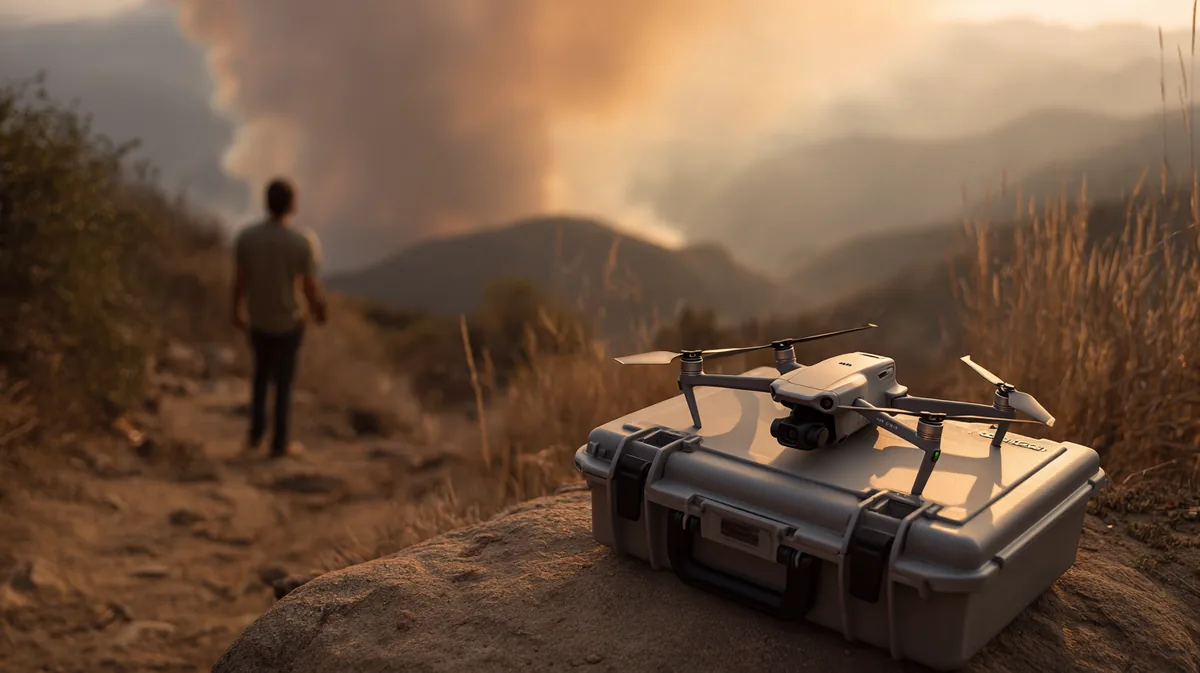
| Penal Code 402 (AB 1680, effective 2017) | Going to an emergency scene to view it and thereby impeding emergency personnel is a misdemeanor; this expressly includes a person, wherever located, operating a drone at the scene. Emergencies include fires, flooding and traffic accidents. | Misdemeanor |
| Civil Code 43.101 (SB 807, effective 2017) | Emergency responders are not liable for damage to a drone that was interfering with the emergency services they were providing. | Your drone can be damaged with no recovery from the responder |
| Penal Code 4577 (SB 1355, effective 2019) | Knowingly and intentionally operating a drone on or above the grounds of a state prison, jail, juvenile hall, camp or ranch is prohibited, except for employees and people with prior permission from the facility authority. | Infraction, $500 fine |
The lesson: when you see smoke, sirens or a response scene, land and stay away.
Where Can You Launch and Land in California?
Launch questions usually come down to who controls the ground. California State Parks allows drones in State Parks, State Beaches, State Historic Parks, State Recreation Areas and State Vehicular Recreation Areas, except where a District Superintendent’s posted order prohibits them. Posted orders can cover a single area or a whole district. Under Title 14, Section 4351 of the California Code of Regulations, drones are not allowed in state wilderness areas, cultural preserves and natural preserves. Commercial use requires a park permit, commercial pilots must submit their FAA authorization to the park district, and commercial filming also requires a California Film Commission permit.
National parks are different. Under National Park Service policy, superintendents use 36 CFR 1.5 to prohibit launching, landing or operating drones on park lands and waters, so drones are generally not allowed in parks such as Yosemite, Joshua Tree or Death Valley without written approval. NPS jurisdiction ends at the park boundary.
- Take off from your own property or from land where the owner has given permission.
- Check posted orders for the specific State Park district before you arrive.
- Confirm city rules for launching from parks, beaches and other public property.
A California Drone Law Checklist for Every Flight
- Decide whether the flight is recreational or Part 107, and carry your TRUST certificate or Remote Pilot Certificate.
- Confirm FAA registration and marking for drones of 250 grams or more, and confirm Remote ID is working.
- Check airspace and TFRs, including wildfire restrictions and stadium events.
- Get LAANC or DroneZone authorization before entering controlled airspace.
- Confirm permission to launch and land, including State Park posted orders and city property rules.
- Frame shots so you do not capture neighbors’ private activities or yards without permission.
- Stay clear of prisons, jails and any emergency scene, and land immediately if responders arrive.
Training for California Drone Pilots
Drone Universities has trained drone pilots since 2014 and is based at 7222 Canoga Ave., Los Angeles, CA 91303. Hobbyists ready to fly for business can start with in-person Part 107 test preparation, and our drone training in California and drone training in Los Angeles pages list options near you. To book, request training online or call 1.818.255.0406.
Frequently Asked Questions
Do I need a license to fly a drone in California?
California does not issue its own drone license. Recreational pilots need the free FAA TRUST certificate, and anyone flying for work or a nonprofit needs an FAA Remote Pilot Certificate under Part 107.
Can I fly a drone over my neighbor’s house in California?
Flying into the airspace above a neighbor’s land to record their private or family activities can make you liable under Civil Code Section 1708.8, with damages and civil fines. Keep your camera away from their property and ask first.
Can I fly a drone in a California state park?
Often yes, but not everywhere. Drones are allowed unless a District Superintendent’s posted order prohibits them, and they are never allowed in state wilderness areas, cultural preserves or natural preserves. Check the district’s posted orders before you go.
Can I fly a drone near a wildfire in California?
No. Wildfire TFRs prohibit drones that are not part of the response, the FAA can impose civil penalties for interference, and Penal Code Section 402 makes impeding emergency personnel with a drone a misdemeanor.
What if I do not pass the Part 107 test after training?
If you do not pass the FAA Part 107 exam after completing our training, we will either refund your training fee or retrain you at no additional cost.