Drone Training in Washington
Drone training in Washington at your location, led by FAA Certified Flight Instructors who travel to teams from Puget Sound to the Inland Northwest.
Drone Universities Courses

5.00 (20K+ Joined)
FAA Part 107 Training
Prepare yourself for the FAA Part 107 Knowledge Test. Learn to fly, how to understand industry-standard flight systems, and most importantly, safe and legal flying practices. If you do not pass the FAA Part 107 exam after completing our training, we will either refund your training fee or retrain you at no additional cost.
DJI Mini 4K included!
Duration
$2,500

4.79 (5.4K Joined)
Advanced Aerial Inspections and Cinematography
This one-day course teaches you advanced aerial photography and videography. All classes are taught by working professionals. Learn what it takes to get great shots for clients like Discovery Channel and National Geographic.
Duration
$1,000

4.96 (2.6K Joined)
This one-day course teaches you all about GIS. You will learn everything you need to successfully collect usable data on your flights. We’ll guide you through planning and flying successful operations, programing flight patterns.
Duration
$1,000

4.87 (1.6K+ Joined)
Drones in Agriculture
Join Drone Universities’ one-day Drones in Agriculture course. Learn precision flights, multispectral imaging, and field methodology to boost crop yield. Sign up now!
Duration
$1,000

4.92 (3.6K Joined)
Drones for Construction and Inspection
Join Drone Universities’ one-day Drones for Construction and Inspection course. Learn drone mapping to reduce errors, save costs, and improve safety in construction and wildfire tracking.
Duration
$1,000

4.82 (2.6K Joined)
Drones for Public Safety and Transportation
Learn to use drones for infrastructure inspection and planning. Our one-day course improves public safety and transportation by saving time, money, and resources.
Duration
$1,000

4.82 (3.7K+ Joined)
Drones in Law Enforcement
Join our one-day Drones in Law Enforcement course to learn tactical drone use for surveillance, accident investigation, and evidence collection. Enhance situational awareness and improve crime scene documentation. Sign up now!
Duration
$1,000

4.89 (3.8K Joined)
Drones for Search and Rescue
Join our one-day Drones for Search and Rescue course to learn efficient search techniques and night operations. Enhance your ability to quickly locate and save lost or injured individuals. Sign up now!
Duration
$1,000
Drone Training Built Around Washington Conditions
Washington gives drone pilots very different environments to work in. Teams around Puget Sound operate beneath the Seattle Class B airspace and near several towered airports and military airfields, while crews in the Columbia Basin may spend the day over irrigated farmland, orchards or hydroelectric facilities. Marine air, low clouds and fog west of the Cascades, and wind and summer heat to the east, all shape how a flight should be planned.
Drone Universities provides drone training in Washington at the site where your pilots will fly. Instructors teach the subjects on the FAA Part 107 Knowledge Test, including airspace, weather, regulations, aircraft performance and emergency procedures, and reinforce them with supervised flight practice, checklists and airspace authorization exercises.
We train individual operators, contractors, ports, utilities, growers, agencies and corporate teams. A course can center on Remote Pilot certification or on applied work such as mapping, inspection and aerial imaging. Commercial operators in Washington also have a state registration step, which we cover during training.
Why Washington Organizations Choose Drone Universities
In operation since 2014
Drone Universities has delivered hands-on drone instruction since 2014, with courses anchored in FAA regulations and real field conditions.
Training at your location
Instructors travel to your office, terminal, farm or facility anywhere in Washington, so your team does not lose days to travel.
FAA Certified Flight Instructors
Classes are taught by FAA Certified Flight Instructors who apply a manned-aviation approach to charts, weather and risk management.
Matched to your mission
Exercises can reflect your work, from pier and crane inspection to orchard scouting, utility patrol and construction mapping.
Easy to schedule
Request training online or call 1.818.255.0406, and our team will help you choose a course, dates and a practical training site.
Cities We Serve in Washington
Our instructors travel to clients across Washington, including:
Seattle
King County organizations working beneath the Seattle Class B airspace and near the Class D airspace at Boeing Field and Renton Municipal Airport.
Tacoma and Olympia
Pierce and Thurston counties, including sites near Tacoma Narrows Airport, Joint Base Lewis-McChord and Olympia Regional Airport.
Everett and Bellingham
Snohomish, Skagit and Whatcom counties, around Paine Field and Bellingham International Airport.
Spokane
Spokane and the Inland Northwest, near the Class C airspace at Spokane International and Fairchild Air Force Base and the Class D airspace at Felts Field.
Tri-Cities and Yakima
Pasco, Kennewick, Richland and the Yakima Valley, around Tri-Cities Airport and Yakima Air Terminal.
Vancouver
Clark County clients, where part of Vancouver lies within the Class C airspace of Portland International Airport across the Columbia River.
Need training somewhere else in Washington, such as Wenatchee, Moses Lake or the Olympic Peninsula? Contact our team and we will plan a course at your site. Organizations with sites across the state line can also see our Oregon drone training page. Request a course location »
Washington Industries Using Drones
- Aerospace and manufacturing. Manufacturers and suppliers use drones to inspect large roofs, hangars and building envelopes and to document plant layouts without lifts.
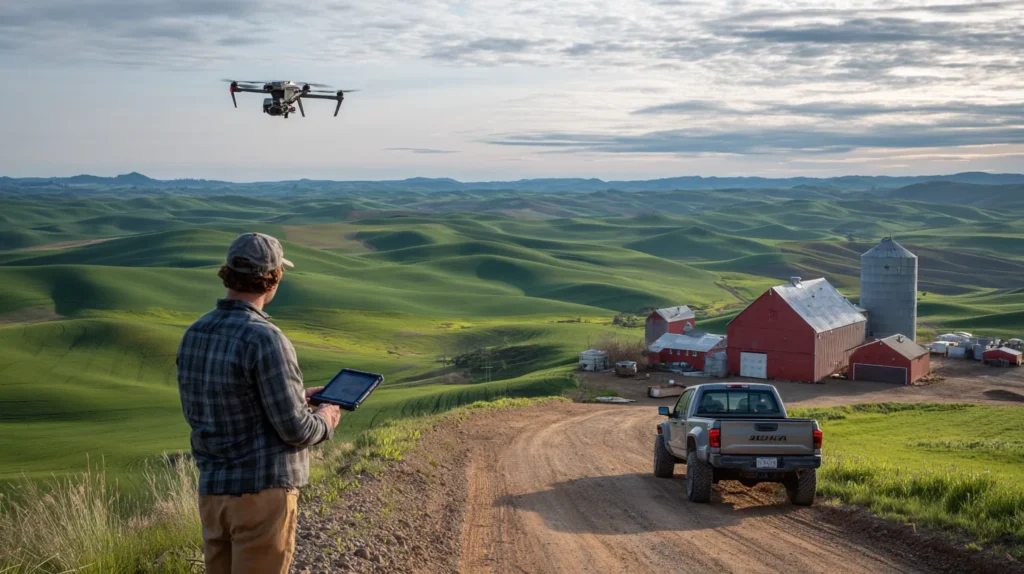
- Agriculture. Orchard, vineyard and row-crop operations in central and eastern Washington use aerial imagery for scouting and irrigation review. Spray drones carry FAA requirements beyond Part 107, which we explain.
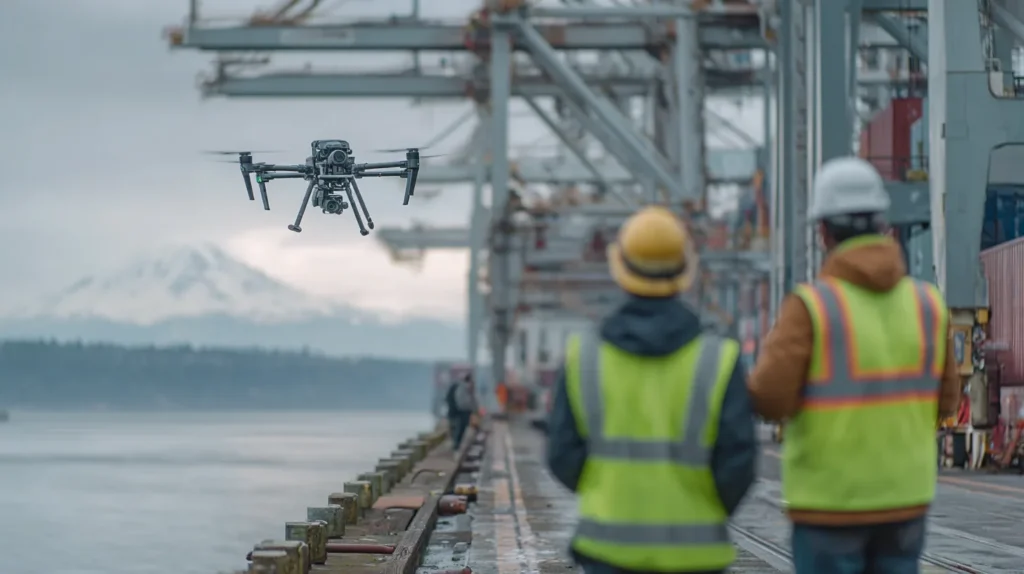
- Ports and maritime. Port, terminal and shipyard operators document piers, cranes, roofs and shoreline structures, often close to controlled airspace.
- Utilities and hydropower. Utilities inspect transmission lines, substations, dams and spillways, much of it in steep or remote terrain.
- Construction and engineering. Contractors and engineering firms record progress, measure stockpiles and map sites for transportation, housing and commercial projects.
- Public safety and wildfire response. Fire districts, sheriff’s offices and emergency management agencies use drones for scene overview, search support and post-fire or flood assessment. Our police drone training programs cover these missions in depth.
We can weight the course toward any of these fields. Organizations training a full team can also review our corporate drone training options.
Washington Drone Laws and Airspace Notes
- Seattle Class B airspace. Seattle-Tacoma International Airport is the primary airport of the Seattle Class B airspace. Part 107 flights in controlled airspace require FAA authorization, usually requested through LAANC or FAA DroneZone.
- Class C and Class D airports. Spokane International, Fairchild Air Force Base and Whidbey Island Naval Air Station (Ault Field) are surrounded by Class C airspace, and the Portland International Class C airspace extends over part of Vancouver. Class D airspace surrounds airports including Boeing Field, Renton Municipal, Paine Field, Tacoma Narrows, McChord Field and Gray Army Airfield, Olympia Regional, Bellingham International, Felts Field, Tri-Cities, Yakima, Walla Walla Regional and Grant County International in Moses Lake.
- State registration for commercial drones. RCW 47.68.250 requires commercial unpiloted aircraft systems operated or based in Washington to be registered with WSDOT each calendar year, in addition to FAA registration. Drones used only for hobby or recreation are exempt. WSDOT Aviation publishes the current process.
- Wildlife and hunting. WAC 220-413-070 makes it unlawful, without a permit, to use a drone to hunt, spot or locate wildlife for hunting, or to pursue or harass wildlife, and to hunt game animals or birds on a day you have operated a drone.
- State parks. Under WAC 352-32-130, drones may fly in Washington state parks only in designated flying areas or with written permission, and Washington State Parks requires a permit for each instance of use.
- National Park Service sites. Under National Park Service policy, launching, landing or operating drones on NPS-administered lands and waters is prohibited except in limited, approved cases. This covers Mount Rainier, Olympic and North Cascades national parks and San Juan Island National Historical Park.
This is general guidance, not legal advice. Before every flight, confirm current FAA, state and local requirements, check for temporary flight restrictions and obtain the property owner’s permission.
How Training at Your Washington Site Works
- Request a course. Send the request form or call us with your location, the size of your group, current experience and the dates you have in mind.
- We plan around your site. We recommend a course, assign an instructor and review airspace, weather patterns and open space at your location before the first day.
- Fly with your instructor. Your instructor teaches on site and supervises hands-on flights in the setting where your pilots will carry out their work.
Request Drone Training in Washington
Whether your team works on the Seattle waterfront, in a Yakima Valley orchard or at a Spokane industrial site, our instructors come to you.
Frequently Asked Questions
Do I need a Part 107 certificate to fly a drone for work in Washington?
Yes. Commercial drone flights in Washington fall under the FAA Small UAS Rule (Part 107). The pilot must hold a Remote Pilot Certificate, which requires passing the FAA knowledge test, and the drone must be registered with the FAA. See the FAA’s guide to becoming a certificated remote pilot. Our courses prepare you for the knowledge test.
Do I also have to register my drone with Washington State?
If you fly commercially, yes. RCW 47.68.250 requires commercial drones operated or based in Washington to be registered with WSDOT every calendar year, separate from FAA registration. Hobby and recreational drones are exempt. Check WSDOT Aviation for the current form and fee.
Can I fly in Seattle?
Often, with planning. Much of the Seattle area lies within the Seattle Class B airspace, with additional Class D airspace around Boeing Field, Renton and Paine Field. You need FAA authorization before flying in controlled airspace, and approved altitudes near the airports can be very low.
Can I fly a drone in a Washington state park?
Only in a designated flying area or with written permission. Washington State Parks requires a permit for each instance of drone use, so apply well before your planned flight.
Where does training take place?
At your location. Instructors travel to offices, ports, job sites, farms, campuses and public safety facilities throughout Washington. If you do not have a suitable flight area, we will discuss options with you.
How do I book drone training in Washington?
Send a training request or call 1.818.255.0406. We will confirm the course, instructor, location and schedule for your Washington training with you.